- ■
Meta introduces parental visibility into AI conversation topics, shifting AI chat from unregulated territory to supervised space
- ■
Topic categories span School, Entertainment, Lifestyle, Travel, Writing, and Health and Wellbeing—establishing taxonomy for AI interaction monitoring
- ■
Policy inflection point: platforms now treating AI conversations as requiring same oversight frameworks as content feeds
- ■
Decision-makers have 6-12 month window before regulatory requirements formalize across competing platforms
Meta just crossed a regulatory threshold that every AI platform will follow. The company's announcement this morning that parents can now monitor topic categories their children discuss with Meta AI—ranging from School and Entertainment to Health and Wellbeing—marks the inflection where AI conversations become subject to the same parental oversight frameworks as social media content. This isn't a technical feature launch. It's the moment conversational AI supervision transitions from optional experiment to policy precedent, signaling that AI interactions with minors now require distinct governance beyond traditional content moderation.
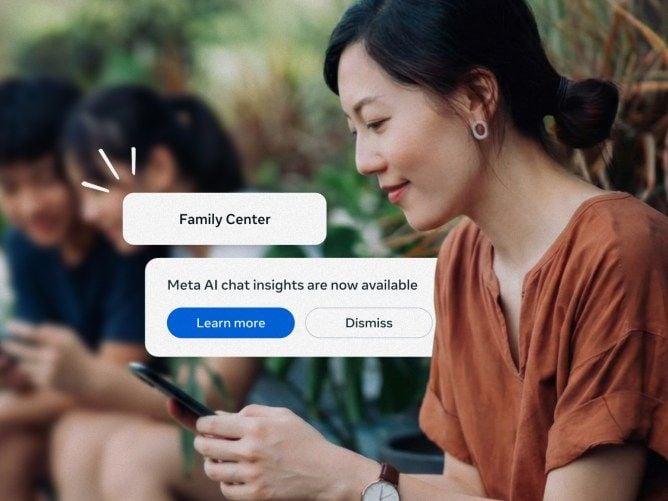
Meta made a policy move this morning that defines how platforms will govern AI interactions with minors for the next decade. Parents using Meta's Family Center can now see categorized topics their children discuss with Meta AI—not the actual conversations, but thematic buckets like School, Entertainment, Lifestyle, Travel, Writing, and Health and Wellbeing, according to the company's announcement.
The feature itself feels incremental. But the timing reveals the transition. Meta is preemptively applying parental control frameworks to AI conversations before regulators demand it, the same playbook the company used with Instagram's teen safety features in 2021. That earlier move came six months before Congressional hearings intensified scrutiny on social platform safety. This follows the pattern.
What's actually shifting is how platforms categorize AI interactions. For two years, conversational AI existed in a governance gray zone—not quite content, not quite feature, subject to terms of service but lacking the structured oversight applied to feeds and posts. Meta's topic monitoring system establishes that AI chats with minors require supervision distinct from both content moderation and general AI safety guardrails.
The taxonomy matters more than the feature. By defining conversation categories, Meta creates a classification system that other platforms will adopt or adapt. Google and OpenAI both offer AI chat products accessible to teens but lack comparable parental visibility tools. Meta just set the baseline they'll need to match.
This mirrors the 2018-2019 inflection when COPPA compliance shifted from theoretical requirement to enforced standard. The FTC's YouTube settlement in September 2019—$170 million for inadequate child privacy protections—accelerated platform policy changes that companies had been slow-rolling for years. Meta is moving early this time.
The privacy calculus is deliberate. Topic-level visibility gives parents oversight without exposing actual conversation content, threading the needle between supervision and student privacy. A parent sees their child discussed "Health and Wellbeing" with Meta AI but not the specific mental health question asked. That distinction will become critical as state-level AI regulation accelerates.
Timing intelligence matters here. California's AI safety bills are advancing through committee stages. The EU's AI Act implementation guidelines for child-facing systems hit draft stage last month. Meta's parental controls arrive precisely when regulatory frameworks transition from theoretical to operational. The company is establishing compliance architecture before mandates arrive.
For competing platforms, the calculation just changed. Snapchat launched My AI to 150 million teens without comparable parental oversight tools. Character.AI offers unlimited conversational AI to users 13 and up with minimal guardian visibility. Meta's move creates competitive pressure to match parental controls or face scrutiny for lagging safety standards.
The technical implementation reveals the complexity ahead. Categorizing open-ended AI conversations into discrete topics requires classification systems that balance accuracy with privacy. Too broad and the categories provide no meaningful oversight. Too specific and they expose sensitive conversation details. Meta's initial taxonomy—eight general categories—suggests the company is starting conservative and will refine based on parent feedback and regulatory response.
This also validates that AI interactions require governance frameworks separate from content moderation. Traditional social media oversight focuses on posted content visible to others. AI conversations are private, dynamic, and personalized. The safety considerations differ—less about viral spread of harmful content, more about one-to-one influence over time. Meta's topic monitoring acknowledges this distinction.
The business implications extend beyond compliance. Platforms that establish robust AI safety frameworks early gain trust advantages as conversational AI becomes central to product experience. Meta AI is now integrated across Instagram, WhatsApp, and Facebook. Parental controls become table stakes for maintaining those integrations in teen-accessible products.
Watch for the regulatory response in the next 90 days. If lawmakers and child safety advocates validate Meta's approach, expect Google and Microsoft to announce similar features by summer. If advocates push for stricter requirements—full conversation logs, age verification, or usage limits—the entire AI chat industry faces a compliance scramble.
The precedent matters most. Meta just established that AI conversations with minors are not exempt from parental oversight frameworks that govern other digital interactions. Every platform building conversational AI now operates with that assumption baked in. The window for treating AI chat as ungoverned experimentation just closed.
Meta's parental AI monitoring crosses conversational AI from experimental territory into regulated compliance space. Decision-makers at platforms with teen-accessible AI products have a narrow window—likely 6-12 months—to implement comparable oversight before regulatory requirements formalize. For policy professionals, this establishes the governance precedent that AI interactions with minors require distinct frameworks beyond content moderation. The companies that move now define the standards. Those that wait will scramble to catch up when mandates arrive. Watch for competing platform announcements in Q2 and Q3 2026 as the new baseline solidifies.