- ■
Samsung deploys Mistral AI on-premises for live fab operations—defect detection and equipment optimization in production environments
- ■
On-premises requirement signals AI reached security/mission-critical threshold for semiconductor manufacturing—data never leaves Samsung's infrastructure
- ■
Samsung leads Mistral's Series D funding round, securing strategic equity stake for long-term technology collaboration across chip ecosystem
- ■
Watch for yield improvement metrics in Q4 2026 earnings—proof AI infrastructure delivers at nanometer scale
Samsung Electronics just crossed the threshold from AI experimentation to production control. The company's deployment of Mistral AI's on-premises models for live fab operations—defect detection and equipment optimization across advanced memory and logic manufacturing—marks the moment AI transitions from chip design assistant to mission-critical manufacturing infrastructure. This isn't AI analyzing designs. It's AI running the nanometer-precision processes that produce the chips themselves, announced during the France-South Korea state summit in Paris.
Samsung Electronics is putting AI in control of the machines that make the chips that run AI. The recursive loop isn't theoretical anymore.
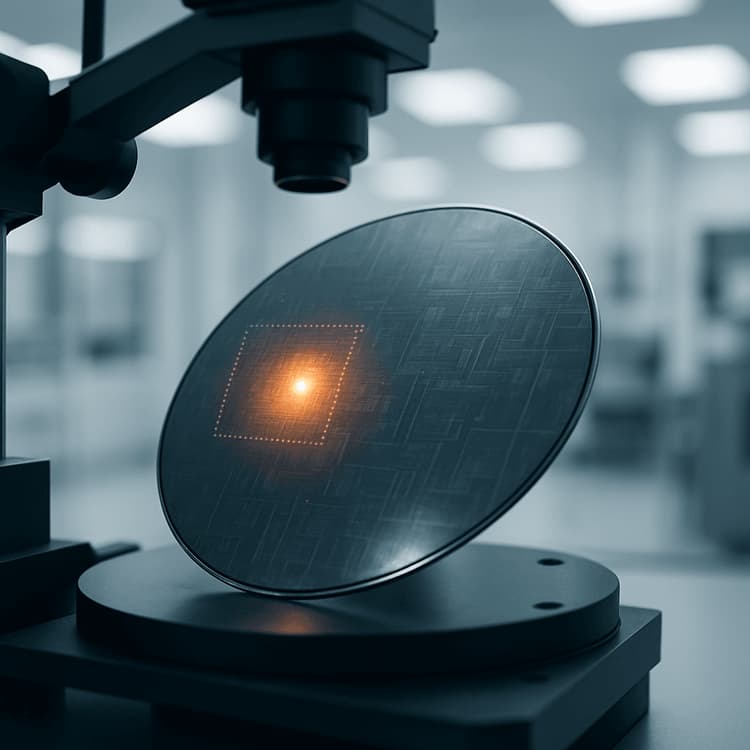
The company announced today it's deploying Mistral AI's large language model—Mistral Large—across its semiconductor operations, but not for the expected use cases. This isn't AI helping engineers write better code or optimize chip layouts during the design phase. Samsung is running Mistral's models on-premises inside its fabs for real-time defect detection and equipment optimization while chips are being manufactured. That's AI operating at the point where a single miscalculation costs millions and nanometer precision determines whether a wafer succeeds or becomes scrap.
The on-premises architecture tells you everything about the inflection point. Samsung built custom infrastructure to keep Mistral's models entirely within its semiconductor facilities—no data leaves the boundary, no external API calls, total control over what the company calls "mission-critical technologies." You don't architect that level of isolation for a pilot program. You build it when AI has become load-bearing infrastructure.
"Increasing complexities involved in AI chip design and manufacturing requires continuous innovation in semiconductor technologies," Young Hyun Jun, Vice Chairman and CEO of Samsung's Device Solutions Division, told reporters. The careful phrasing—"design and manufacturing"—places AI in both pre-production and production environments. That's the shift.
The numbers are what matter here. Samsung's advanced nodes operate at tolerances measured in single-digit nanometers. At 3nm and below, the margin for error approaches the atomic scale. Traditional statistical process control catches defects after they happen. AI models analyzing sensor data in real-time can predict equipment drift before it impacts yield, adjust parameters on the fly, and identify defect patterns that human engineers would need weeks to recognize. Arthur Mensch, Mistral's co-founder and CEO, framed it as "reshaping how we build complex technologies, from silicon to software."
But here's the precedent this sets: semiconductor manufacturing just became an AI infrastructure deployment case study for every other precision manufacturing vertical. If AI can handle the complexity and risk profile of fab operations—where a contamination event can destroy $100 million in work-in-progress inventory—it can handle automotive assembly, pharmaceutical production, aerospace manufacturing. Samsung is validating the category.
The timing aligns with Samsung leading Mistral's Series D funding round, announced separately at a reported $24 billion valuation. The equity stake isn't financial engineering. It's strategic alignment on the technology roadmap. Samsung needs Mistral's models to keep improving at the pace its manufacturing complexity is increasing. Mistral needs Samsung's deployment data to train models that work in the highest-stakes production environments in technology.
This mirrors the pattern we saw when cloud providers became AI infrastructure companies. AWS, Azure, and Google Cloud didn't just host AI workloads—they became the substrate AI ran on. Samsung is doing the same thing one layer down the stack. The chips that enable AI are now being manufactured by AI, creating a feedback loop that accelerates both sides.
The competitive implications are immediate. TSMC and Intel now face pressure to demonstrate equivalent AI deployment in their fabs. Chip customers—Apple, Nvidia, AMD—will start asking about AI-optimized manufacturing processes as a differentiator. The companies that figure out AI-driven yield optimization fastest will have a structural cost advantage measured in billions.
For enterprises watching this, the lesson isn't about semiconductors. It's about when AI crosses from tool to infrastructure. Samsung's on-premises requirement sets the template: when AI touches your core production process, you need architectural control. That means local deployment, custom models, and infrastructure investment that looks excessive until it becomes essential.
The technical details matter. Samsung is running Mistral Large—not a smaller, faster model—which suggests the company needs the reasoning capability of frontier models even in latency-sensitive manufacturing environments. That's a bet that model intelligence matters more than inference speed, at least for the defect detection and optimization use cases. It's also validation that modern LLMs can operate in real-time production systems if you architect correctly.
The announcement came during a state summit in Paris, which adds a geopolitical layer. France and South Korea positioning AI-enabled semiconductor manufacturing as a strategic partnership—not just a commercial deal—signals how countries are thinking about chip supply chain resilience. If AI improves yield and reduces manufacturing risk, it becomes a tool for semiconductor sovereignty.
What to watch next: Samsung's yield metrics in Q4 2026 earnings. If defect rates improve or ramp times accelerate on new nodes, that's proof AI infrastructure delivers measurable value at nanometer scale. Then watch for TSMC's response—the world's leading foundry can't cede manufacturing intelligence to a competitor. And watch for Mistral's product roadmap. Building models that work in Samsung's fabs gives them domain expertise no other AI company has.
Samsung's deployment of Mistral AI in live fab operations marks AI crossing from assistant to infrastructure in the world's most complex manufacturing environment. Builders should study the on-premises architecture pattern—this is how AI gets deployed when stakes are mission-critical. Investors now have validation that manufacturing AI is a fundable category with strategic equity backing. Decision-makers in precision manufacturing should watch Samsung's Q4 yield metrics—proof that AI infrastructure delivers at nanometer scale. The recursive loop is live: AI is now making the chips that run AI, and the companies that master this first will have a structural advantage measured in billions.