- ■
Lotus Health claims all-50-state medical licensing for AI-delivered primary care, a regulatory achievement that—if verified—signals healthcare delivery infrastructure is finally treating AI as licensed provider, not experimental tool.
- ■
Free primary care model scales: Lotus claims 10x patient throughput vs. traditional practice (15-minute visits, 24/7 availability), addressing documented primary care physician shortage while eliminating consumer friction. No existing paid telehealth competitor operates at zero revenue.
- ■
Business model remains venture arbitrage, not sustainable economics. Dhaliwal told TechCrunch 'current focus remains entirely on product development and attracting patients rather than revenue.' Eventual models include 'sponsored content or subscriptions'—translation: To be determined.
- ■
Watch for regulatory follow-through: If 50-state licensing claim survives scrutiny, other AI healthcare startups (Doctronic, others) will fast-follow. If it's limited licensing, the entire positioning collapses.
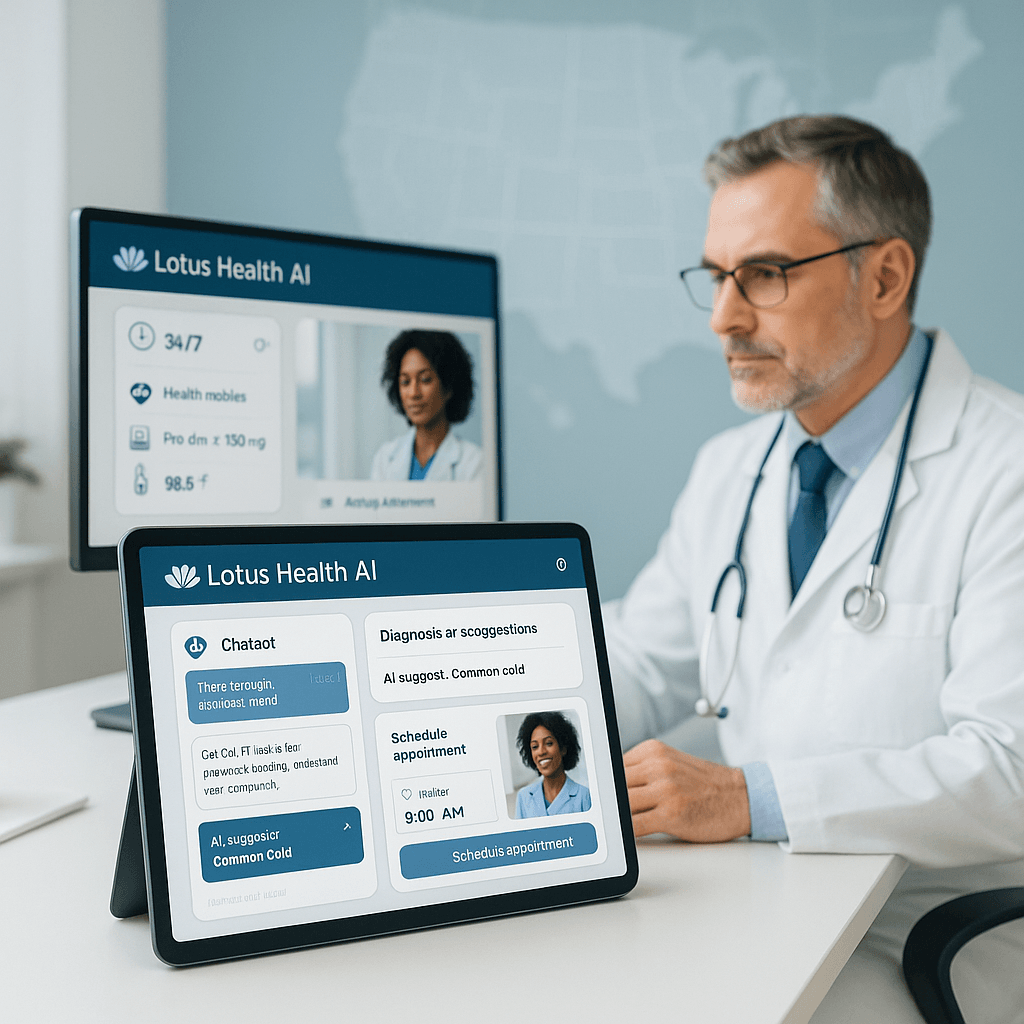
The calculus of American primary care just shifted. Lotus Health closed a $35 million Series A co-led by CRV and Kleiner Perkins—bringing total funding to $41 million—to scale an AI doctor licensed in all 50 states, available 24/7 in 50 languages, and offered entirely free of charge. That last detail changes everything. Healthcare AI has been mostly experimental until now. Lotus moves the inflection from chatbot-assisted diagnosis to actual medical care delivery: diagnosis, prescriptions, specialist referrals, all reviewed by board-certified doctors from Stanford, Harvard, and UCSF before reaching patients. The question isn't whether AI can do primary care. The question is: who captures the margin when venture capital subsidizes care below cost?
The healthcare industry's biggest inefficiency isn't technology—it's scarcity. There aren't enough primary care doctors. Ask any enterprise health plan: primary care appointment wait times have doubled since 2019, and the physician shortage is structural, not cyclical. That scarcity has always meant pricing power. Telehealth disrupted the margin but not the scarcity. Now AI is attempting something bolder: eliminate scarcity by making the provider scalable.
Lotus Health's move is audacious because it reframes AI healthcare from consumer gimmick to clinical infrastructure. When KJ Dhaliwal—who sold the dating app Dil Mil for $50 million in 2019—launched Lotus in May 2024, he wasn't building another ChatGPT wrapper. He built a licensed medical practice. The AI does the heavy lifting (patient intake, evidence synthesis, treatment planning), but board-certified physicians from tier-one academic health systems review every diagnosis, lab order, and prescription before it reaches the patient. That's the bridge between AI capability and regulatory acceptance.
The all-50-states licensing claim is the inflection point worth monitoring. State medical boards have historically restricted physicians to states where they hold individual licenses—a fragmentation that's made national telehealth providers build elaborate state-by-state networks. If Lotus has genuinely navigated that regulatory maze with an AI system, it signals something larger: medical boards are treating AI as a licensable entity, not an experimental tool requiring physician supervision on a case-by-case basis. Saar Gur, the CRV partner who led the deal, pointed out the regulatory precedent bluntly: telemedicine frameworks established during the pandemic, combined with recent AI breakthroughs, created the opening. "It's a big swing," Gur said. But the risk is narrower than it appears. The regulatory hurdles are real but not insurmountable—they're architectural, not scientific.
What makes Lotus different from competitors like Doctronic (backed by Lightspeed) is the pricing. Doctronic and traditional AI telehealth startups operate on the standard SaaS model: subscription or per-visit fees. Lotus is completely free. This isn't sustainability—it's acquisition strategy. Dhaliwal acknowledged the obvious: "eventual business models may include sponsored content or subscriptions, but the current focus remains entirely on product development and attracting patients rather than revenue." Translation: Build the patient base first, figure out how venture investors get returns later. It's the DoorDash/Uber playbook applied to healthcare—subsidize adoption until you own the market, then capture margins through volume, data, or vertical integration.
But here's where the story gets complicated. Primary care is different from food delivery. There's no venture playbook for building a profitable free healthcare service at scale. The unit economics don't work unless one of three things happens: (1) The AI becomes so efficient that board-certified physician review drops to 5% of cases instead of 100%; (2) Sponsored pharma content or insurance partnerships generate revenue per patient; or (3) The startup becomes an acquisition target for a health system, health plan, or pharmaceutical company willing to absorb the free service as a customer acquisition funnel. Dhaliwal's vagueness about business models isn't evasion—it's honesty. Nobody's solved this yet.
The timing is crucial. Primary care supply is genuinely constrained. Physician shortage data shows no relief in sight. Health plans and employers are desperate for solutions that don't involve hiring more doctors (impossible) or paying more for existing ones (politically untenable). Lotus arrives at the exact moment when decision-makers are open to unconventional models. For patients, the value prop is obvious: free, 24/7 primary care beats waiting three weeks for a telehealth appointment you have to pay $150 for.
The regulatory credibility question matters most right now. The 50-state licensing claim will either become the industry standard or prove to be marketing overclaim. If it's real, expect rapid follow-through from Doctronic and others. If it's limited (perhaps Lotus means "can serve patients in 50 states under specific telemedicine exemptions" rather than operating as a licensed entity nationwide), the positioning collapses. This distinction determines whether we're watching a healthcare inflection point or a well-funded niche player.
What Lotus has genuinely accomplished is shrinking the gap between AI capability and clinical credibility. The board-certified physician review layer is crucial—it's not theater. Stanford, Harvard, and UCSF physicians co-signing AI diagnoses gives the service clinical legitimacy that pure-AI competitors lack. That's defensible. Whether it's profitable is a different question entirely.
Lotus Health represents a real inflection point, but one still in formation. The all-50-state licensing claim—if verified—signals that medical boards are ready to treat AI as a clinical entity, not an experimental addon. For investors, the window to back healthcare AI delivery is open now, but the business model arbitrage (free service → profitable exit) remains unvalidated. For health plan decision-makers, the timing is urgent: if Lotus solves the unit economics problem, traditional telehealth pricing becomes obsolete within 18 months. For physicians and healthcare professionals, this accelerates a transition they should be preparing for now—AI-assisted triage is becoming the primary care delivery model, not a future scenario. The next threshold to watch: patient volume and clinical outcomes data. Lotus will need to demonstrate both before Series B capital arrives.